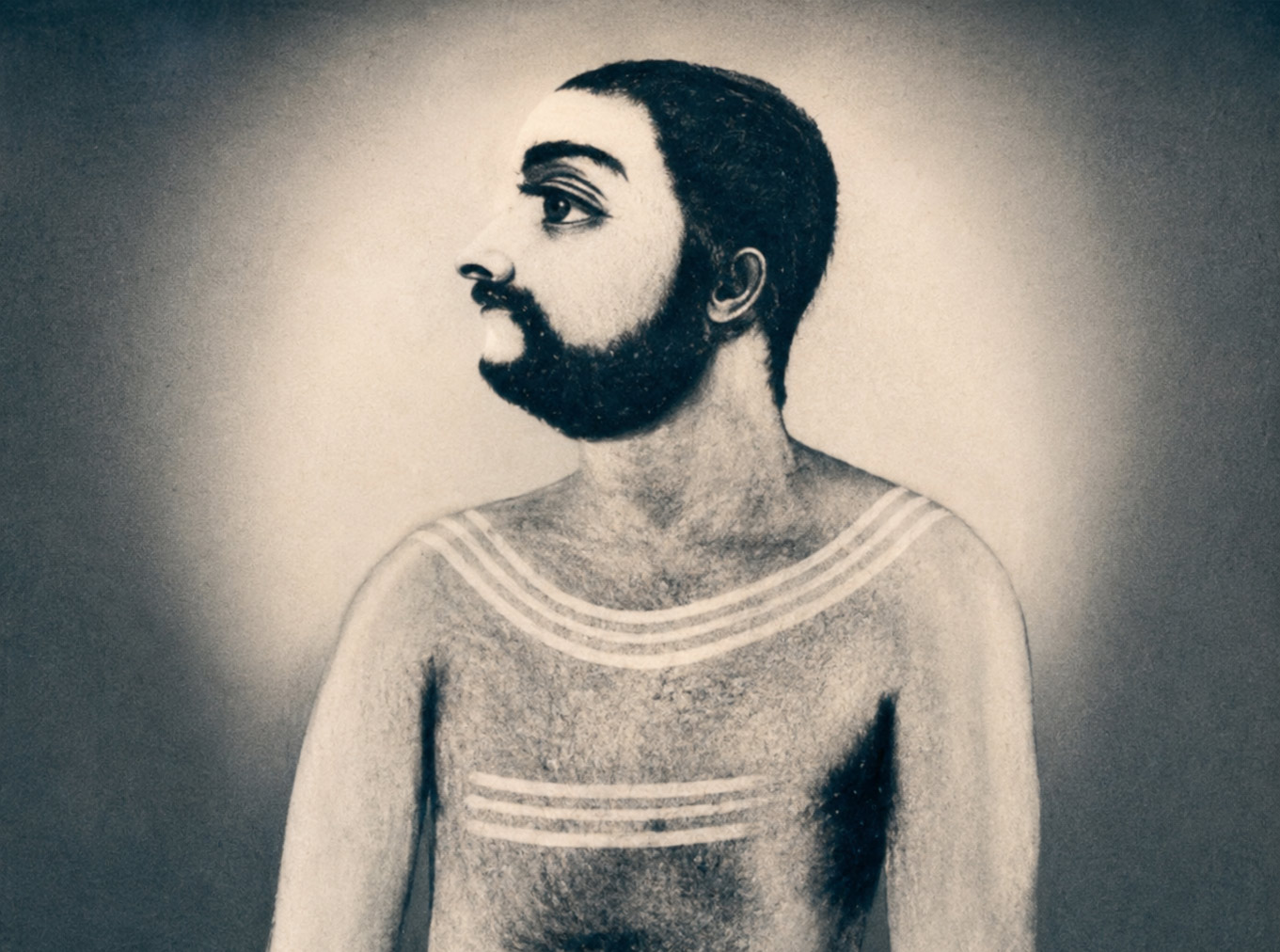
The Divine Dawn: Birth, Childhood and the Making of a Sage
Sadguru Sri Sadasiva Brahmendra - Part I
Before the world knew the silent Avadhuta, before generations of devotees spoke of his extraordinary leelas, before his immortal compositions carried the fragrance of Advaita across centuries, there was a child named Sivaramakrishna.
Some saints teach through scriptures.
Some teach through sermons.
Some establish institutions and gather disciples around them.
Some sing the Divine Name until their songs become inseparable from the spiritual culture of a land.
But once in a great while, there appears a sage whose greatest teaching is neither a book nor a discourse.
It is silence.
Sadguru Sri Sadasiva Brahmendra belongs to that rare tradition.
Remembered as an Advaita sage, Avadhuta, yogi, Sanskrit scholar and composer, Sri Sadasiva Brahmendra occupies a distinctive place in the spiritual heritage of Bharat. His compositions continue to be sung. His Advaitic works continue to inspire seekers. His sacred association with Nerur continues to draw devotees.
Yet the extraordinary figure remembered by later generations did not suddenly appear as the silent sage.
There was a beginning.
There was a childhood.
There was education.
There was questioning.
There was an awakening.
There was a gradual loosening of the bonds connecting an individual to ordinary worldly life.
And there was the irresistible call of the Eternal.
To understand Sri Sadasiva Brahmendra, therefore, we must first travel back to the world into which Sivaramakrishna was born.
This is not yet the story of the famous miracles.
It is the story of the making of the one through whom those extraordinary traditions would later unfold.
It is the story of the Divine Dawn.
A Saint Between History and Sacred Memory
Writing the life of a saint such as Sri Sadasiva Brahmendra requires a different approach from writing an ordinary biography.
An ordinary historical life may be reconstructed through letters, official records, contemporary portraits and carefully dated documents.
The lives of India's wandering saints were rarely preserved in this manner.
Their followers remembered encounters.
Disciples preserved teachings.
Villages preserved stories.
Sacred institutions maintained traditions.
Compositions survived after the physical voice of the composer disappeared.
And incidents regarded as expressions of divine grace passed from one generation to another.
Sri Sadasiva Brahmendra's life comes to us through precisely such a meeting of history and sacred memory.
For that reason, this series follows an important principle.
Where historical details are reasonably established, they will be presented as such.
Where accounts primarily belong to traditional or devotional memory, they will be introduced as tradition.
This distinction does not diminish devotion.
Rather, it allows us to honour both truthfulness and sacred tradition.
For the devotee, moreover, dates alone cannot explain a sage.
A birth certificate could tell us when a person entered the world.
It could never explain how that person came to live beyond identification with the world.
For that, we must enter the spiritual story.
I. The Sacred Soil of South India
Sri Sadasiva Brahmendra is generally placed in the spiritual world of South India during the seventeenth and eighteenth centuries.
It was a landscape in which temple worship, Vedic learning, Sanskrit scholarship, devotional movements, music, pilgrimage and philosophical inquiry lived alongside one another.
The temple was not merely a structure.
It was a centre of community life.
The river was not merely water.
It was sacred.
Learning was not merely a means of livelihood.
At its highest level, knowledge was regarded as a path toward understanding the nature of existence itself.
A child growing within such a culture could encounter the Ramayana and Mahabharata not merely as literature but as living sacred narratives.
The Vedas were heard in recitation.
The Divine Name was repeated in homes and temples.
Pilgrims moved from kshetra to kshetra.
Teachers transmitted knowledge through disciplined study.
Philosophical questions concerning the Self, God, bondage and liberation were not abstract curiosities alone. For serious seekers, they concerned the ultimate purpose of human birth.
It was within this spiritually charged world that the child who would later become known as Sri Sadasiva Brahmendra entered life.
II. The Birth of Sivaramakrishna
Traditional biographical accounts identify the parents of Sri Sadasiva Brahmendra as Somasundara Avadhani and Parvati and associate his birth with a Telugu Brahmin family in Madurai.
The child was named Sivaramakrishna.
Even the name carries a beautiful spiritual resonance.
Siva. Rama. Krishna.
Three names deeply woven into the devotional consciousness of Bharat appear together in the name of the child who would eventually transcend attachment to name and form itself.
Traditional accounts surrounding his birth contain deeply devotional elements.
One such tradition relates the parents' prayers for a child and their association with worship connected with Sri Ramanathaswamy at Rameswaram. Some accounts also preserve a tradition concerning Rama Nama japa undertaken by his mother.
Such details belong principally to the devotional biography of the saint rather than to independently established modern historical documentation.
Yet their significance within the tradition is unmistakable.
The birth of Sivaramakrishna was remembered not simply as the arrival of another child into a household.
In retrospect, devotees saw it as the first visible chapter in a life destined for extraordinary spiritual heights.
III. When a Great Life Begins Quietly
One of the most beautiful features of a saint's childhood is that those around the child cannot yet see the complete future.
The mother sees her son.
The father sees his child.
The teacher sees a student.
Neighbours see a young boy growing among them.
History sees none of this until much later.
Only after the life has unfolded do earlier moments acquire a different meaning.
A child's unusual seriousness becomes the first hint of vairagya.
A hunger for learning becomes preparation for jnana.
A question asked before a teacher becomes evidence of an intellect that would later penetrate much deeper questions.
A moment of silence becomes a distant foreshadowing of the sage who would one day make silence itself his language.
So it was with Sivaramakrishna.
He had not yet become the wandering Avadhuta.
He had not yet become the sage of Nerur.
He had not yet become the composer whose spiritual songs would survive for centuries.
The seed was still beneath the soil.
But something had already begun.
IV. From Madurai Toward a World of Learning
Traditional accounts associate Sivaramakrishna's family initially with Madurai and subsequently with Tiruvisainallur, near Kumbakonam.
Tiruvisainallur - also encountered in sources under variant spellings - occupies an important place in accounts of his early education.
This geographical movement matters.
The Kaveri region was home to vibrant traditions of Vedic study, Sanskrit learning, temple culture and bhakti.
For Sivaramakrishna, education would not simply fill his mind with information.
It would provide him with the intellectual instruments through which he could eventually investigate the most fundamental question:
Who am I?
V. Education in the Sacred Tradition
Traditional accounts describe Sivaramakrishna as receiving a strong education in the learning of his time.
The young student entered a world in which education required discipline.
The Vedas were preserved through precise oral methods.
Sanskrit demanded attention to grammar and structure.
Philosophical learning demanded more than memorisation.
A serious student had to listen, reflect, question and understand.
And Sivaramakrishna is remembered as an exceptionally gifted learner.
His intellect appears in traditional accounts as sharp, penetrating and naturally suited to debate and philosophical reasoning.
But intellectual brilliance has two possible destinations.
It can strengthen the ego.
Or it can eventually destroy the illusion upon which the ego stands.
In Sivaramakrishna's life, learning would ultimately serve the second purpose.
VI. Knowledge and the Young Sivaramakrishna
Imagine the questions that arise in a mind exposed deeply to Vedantic thought.
What is permanent?
What changes?
If the body changes continuously, can the body alone be the Self?
If thoughts come and go, who knows their coming and going?
What remains through waking, dream and deep sleep?
What is the nature of happiness?
Can anything obtained from the world provide happiness that never disappears?
What is liberation?
What is Brahman?
Is the Divine distant from us - or is the ultimate Reality the very ground of our existence?
For most people, such questions appear occasionally and then disappear when everyday life calls.
For a genuine seeker, they become impossible to ignore.
The spiritual trajectory remembered in Sivaramakrishna's life suggests that scriptural knowledge was gradually becoming something more than scholarship.
Knowledge was turning inward.
VII. The Difference Between Knowing and Realizing
This distinction is essential to understanding the making of Sri Sadasiva Brahmendra.
One may know the definition of Brahman.
One may explain Advaita.
One may debate subtle philosophical positions.
One may quote the Upanishads.
One may speak eloquently about Atman.
And still remain bound by anger, desire, pride, fear and attachment.
Vedanta therefore demands something far greater than intellectual mastery.
It demands realization.
There is an immense difference between saying:
“I am not merely this body.”
and actually living without bondage to bodily identity.
There is a difference between declaring:
“Everything is Brahman.”
and directly perceiving no second reality apart from Brahman.
The later life of Sri Sadasiva Brahmendra would become extraordinary precisely because the boundaries that ordinary people regard as unquestionable appeared to lose their hold upon him.
But that flowering belonged to the future.
The young Sivaramakrishna was still approaching the threshold.
VIII. The First Stirring of Vairagya
Every great renunciate encounters, in one form or another, a decisive recognition:
What the world offers cannot satisfy the deepest hunger of the soul.
This recognition is called vairagya - dispassion or detachment.
Vairagya should not be misunderstood as hatred of life.
True vairagya is clarity.
It is the recognition that everything conditioned by time must eventually change.
Youth changes.
Beauty changes.
Possessions pass from hand to hand.
Status rises and falls.
Relationships change through circumstance and death.
The body itself moves inevitably through childhood, youth, maturity and decline.
The world may provide countless experiences.
But can any changing experience provide the unchanging Reality sought by the deepest spiritual inquiry?
For Sivaramakrishna, this question appears to have become increasingly powerful.
IX. The Householder Path and the Call Beyond It
Traditional biographies also preserve accounts of Sivaramakrishna entering marriage at a young age, in keeping with social customs of the period.
The exact details surrounding his departure from household life vary in retelling.
One widely circulated traditional narrative connects a domestic incident surrounding food and family arrangements with a sudden intensification of his dispassion.
The deeper meaning of such a story is more important than treating every dramatic detail as independently established history.
Something within him had changed.
The world had not necessarily changed.
His way of seeing it had.
That distinction is at the heart of spiritual awakening.
Two people may stand before the same world.
One sees endless objects to possess.
Another sees impermanence.
One sees opportunities for identity.
Another sees passing appearances.
One asks:
“What can I acquire?”
The seeker begins asking:
“What remains when everything acquired disappears?”
Sivaramakrishna was moving toward the second question.
X. The Fire of Mumukshutva
Vedanta speaks not only of vairagya but of mumukshutva - the intense longing for liberation.
This is not ordinary curiosity.
A curious person wants to know what enlightenment means.
A mumukshu wants liberation itself.
The distinction is enormous.
Spiritual truth is no longer one interest among many.
It becomes the central purpose of existence.
For such a seeker, wealth cannot replace liberation.
Recognition cannot replace liberation.
Scholarship cannot replace liberation.
Pleasure cannot replace liberation.
Even religious learning cannot replace liberation.
The hunger is for Truth itself.
The life of Sivaramakrishna was moving in this direction.
The brilliant student was becoming the seeker.
And the seeker was approaching the Guru.
XI. Why the Guru Becomes Necessary
In the Indian spiritual tradition, the Guru is not merely an academic instructor.
A teacher may explain a text.
The Guru points the disciple toward the Truth to which the text points.
A teacher may provide information.
The Guru destroys ignorance.
A teacher may sharpen the intellect.
The Guru can direct that sharpened intellect inward, toward its own source.
For the seeker of Advaita, this relationship is especially profound.
The fundamental ignorance is not simply ignorance of a fact.
It is mistaken identity.
We say:
“I am the body.”
“I am my thoughts.”
“I am my successes.”
“I am my failures.”
“I am what others think of me.”
“I am the story I have constructed about myself.”
Vedanta asks the seeker to investigate the one who makes all these statements.
Who is this “I”?
What is present before a thought arises?
Who knows the thought?
Can the knower itself be known as an object?
Such inquiry requires subtle guidance.
Sivaramakrishna's journey would lead him toward that guidance.
XII. Sri Paramasivendra Saraswati
A decisive name enters the story at this point:
Sri Paramasivendra Saraswati.
Sri Sadasiva Brahmendra is traditionally remembered as his disciple.
This Guru-disciple relationship would become foundational to the transformation of Sivaramakrishna.
The young scholar had acquired learning.
Now learning had to ripen into wisdom.
Argument had to become contemplation.
Concept had to become experience.
Knowledge had to become Being.
The path ahead was no longer about accumulating more identities.
It was about discovering that which exists before every identity.
XIII. From Sivaramakrishna Toward Sadasiva
Renunciation in the highest spiritual sense is not merely a change of clothing.
Nor is it simply leaving a house.
One may abandon possessions while carrying an enormous ego.
One may live in a forest while mentally living in the marketplace.
One may wear the marks of renunciation while remaining deeply attached to praise and recognition.
True sannyasa points toward something much deeper:
the renunciation of false identification.
This is why Sivaramakrishna's transition toward the life of a renunciate is so important.
The child given a family name was moving toward a state beyond personal identity.
The student known for intellectual ability was moving toward a wisdom beyond argument.
The speaker would eventually become silent.
The scholar would become an Avadhuta.
Sivaramakrishna was moving toward Sadasiva.
XIV. The Spiritual Meaning of His Early Life
At first glance, the childhood of a saint may seem less dramatic than the miracles associated with later years.
But spiritually, these early chapters may be even more important.
A miracle astonishes us.
A transformation teaches us.
The early life of Sri Sadasiva Brahmendra shows a movement that every sincere seeker can understand:
Learning → Inquiry → Dispassion → Longing for Liberation → Guru → Renunciation → Realization.
We may not become wandering Avadhutas.
We may not abandon our homes.
We may have families, careers and responsibilities.
Yet the inner questions remain relevant.
What am I living for?
What part of my identity is permanent?
What happens when circumstances change?
Where does happiness actually arise?
What remains when thought becomes silent?
Who am I beneath every role?
The young Sivaramakrishna's journey invites these questions.
XV. The Seed of the Avadhuta
Looking backward from his later life, his childhood acquires another dimension.
The silent wandering sage was once a student learning words.
The one who would transcend social conventions was once a child growing within them.
The sage remembered as indifferent to bodily consciousness was once cared for by parents.
The composer who would celebrate the all-pervading Brahman first encountered spiritual knowledge through learning.
Nothing about the beginning needs to appear spectacular.
A seed does not resemble a vast tree.
Yet the entire possibility of the tree is hidden within it.
So too, the beginnings of a realized life may appear quiet.
The Divine Dawn rarely announces the full brightness of the coming day.
XVI. Beyond Scholarship
Sri Sadasiva Brahmendra's later reputation as an Advaita master makes one lesson from his early development especially significant.
Spiritual knowledge must become lived knowledge.
Suppose a person repeats:
“Sarvam Brahmamayam” - All is Brahman.
It is a magnificent statement.
But if the same person immediately divides the world through hatred, pride and ego, the words remain intellectual.
What happens when the statement is realized?
The distinction between sacred and ordinary begins to dissolve.
The obsession with “mine” and “not mine” weakens.
The ego ceases to occupy the centre of experience.
The sage does not merely believe in unity.
The sage abides in it.
Sri Sadasiva Brahmendra would eventually become remembered precisely for such radical absorption.
His early scholarship was therefore not the destination.
It was preparation.
XVII. Silence Was Waiting
There is something deeply poetic about the fact that a man remembered for silence began as an exceptional scholar.
Words took him toward the edge.
Scripture pointed beyond itself.
Philosophy clarified the path.
The Guru would reveal the direction.
Meditation would deepen it.
And eventually there would be nowhere further for language to go.
This is one of the great paradoxes of Vedanta.
We use words to discover that the highest Truth cannot be contained by words.
We use thought to investigate the source of thought.
We study distinctions until we discover the non-dual Reality beneath distinction.
For Sivaramakrishna, the journey through knowledge was preparing him for the great silence ahead.
XVIII. What Makes a Sage?
Was Sri Sadasiva Brahmendra great because extraordinary events were later associated with him?
That would be an incomplete understanding.
Was he great because he composed beautiful songs?
Again, incomplete.
Was he great because he possessed philosophical knowledge?
Still incomplete.
The greatness attributed to the sage rests ultimately upon something far deeper:
freedom from the limited self.
The miracles remembered by tradition become meaningful only in relation to this.
They are not the centre.
Realization is the centre.
A genuine spiritual master does not exist to entertain the world with supernatural phenomena.
The master points beyond the world of phenomena altogether.
This distinction will become increasingly important as our series enters the extraordinary stories traditionally associated with Sri Sadasiva Brahmendra.
XIX. A Child Was Disappearing; a Sage Was Emerging
There comes a point in every spiritual biography when the ordinary categories of life begin to fail.
Son.
Student.
Scholar.
Husband.
Householder.
These identities belong to the social world.
Sivaramakrishna had inhabited them.
But something within him was moving toward a truth that could not be contained by any of them.
Who are you when every label is removed?
Who are you without your profession?
Without your possessions?
Without your relationships?
Without your memories?
Without even the body as your fundamental identity?
Vedanta's answer is breathtaking:
You are not the passing label.
You are the consciousness in whose presence every label appears and disappears.
Sivaramakrishna was approaching the experiential depth of this truth.
And once such knowledge becomes direct realization, returning to ordinary identification becomes impossible.
XX. The Dawn Before the Great Silence
Our first chapter therefore ends not with a spectacular miracle but at a threshold.
Sivaramakrishna has been born.
He has entered the sacred world of traditional learning.
His intellect has developed.
The scriptures have opened before him.
Questions have deepened.
The impermanence of worldly existence has begun to reveal itself.
Vairagya has awakened.
The longing for liberation has become stronger.
And the presence of the Guru has entered the horizon.
The young seeker stands between two worlds.
Behind him lies the familiar world of family, education, social identity and expectation.
Before him lies the unknown.
Renunciation.
Discipleship.
Meditation.
Silence.
Self-realization.
And eventually, the astonishing life of the Avadhuta.
The world knew him first as Sivaramakrishna.
Future generations would bow to him as Sadguru Sri Sadasiva Brahmendra.
But between those two names lay a spiritual transformation of extraordinary depth.
That transformation is where our next journey begins.
The Eternal Message of Part I
The childhood of Sri Sadasiva Brahmendra reminds us that spiritual greatness does not begin with miracles.
It begins with awakening.
It begins when a human being stops accepting temporary things as the final purpose of existence.
It begins when knowledge becomes inquiry.
It deepens when inquiry becomes longing.
It becomes transformative when longing leads to the Guru.
And ultimately, the path reaches fulfilment when the seeker discovers that the Reality being sought was never truly separate from the seeker.
Sivaramakrishna's childhood was the dawn.
The sun of realization had not yet reached its zenith.
But the first light had appeared.
Soon, the brilliant student would enter more deeply into the presence of his Guru.
The power of his intellect would be confronted by something greater than intellectual brilliance.
The urge to debate would give way to the discipline of silence.
The seeker would move toward renunciation.
And the personality called Sivaramakrishna would gradually disappear into the boundless consciousness celebrated by Advaita.
A silent sage was being born.
The Avadhuta was waiting.
And one of the most extraordinary spiritual journeys remembered in the sacred traditions of South India was only beginning.
Continue the Sacred Journey
Part II - At the Feet of the Guru: The Path to Renunciation
In the next part, we enter one of the decisive periods in the life of Sadguru Sri Sadasiva Brahmendra: his movement away from worldly identity, his relationship with Sri Paramasivendra Saraswati, the discipline of the Guru, the transformation of extraordinary scholarship into spiritual wisdom, and the path that would eventually lead him into profound silence.
To be continued…
Sadguru Sri Sadasiva Brahmendra Series - Part I of X
Written by Siva Muralidharan
Salutations to Sadguru Sri Sadasiva Brahmendra.