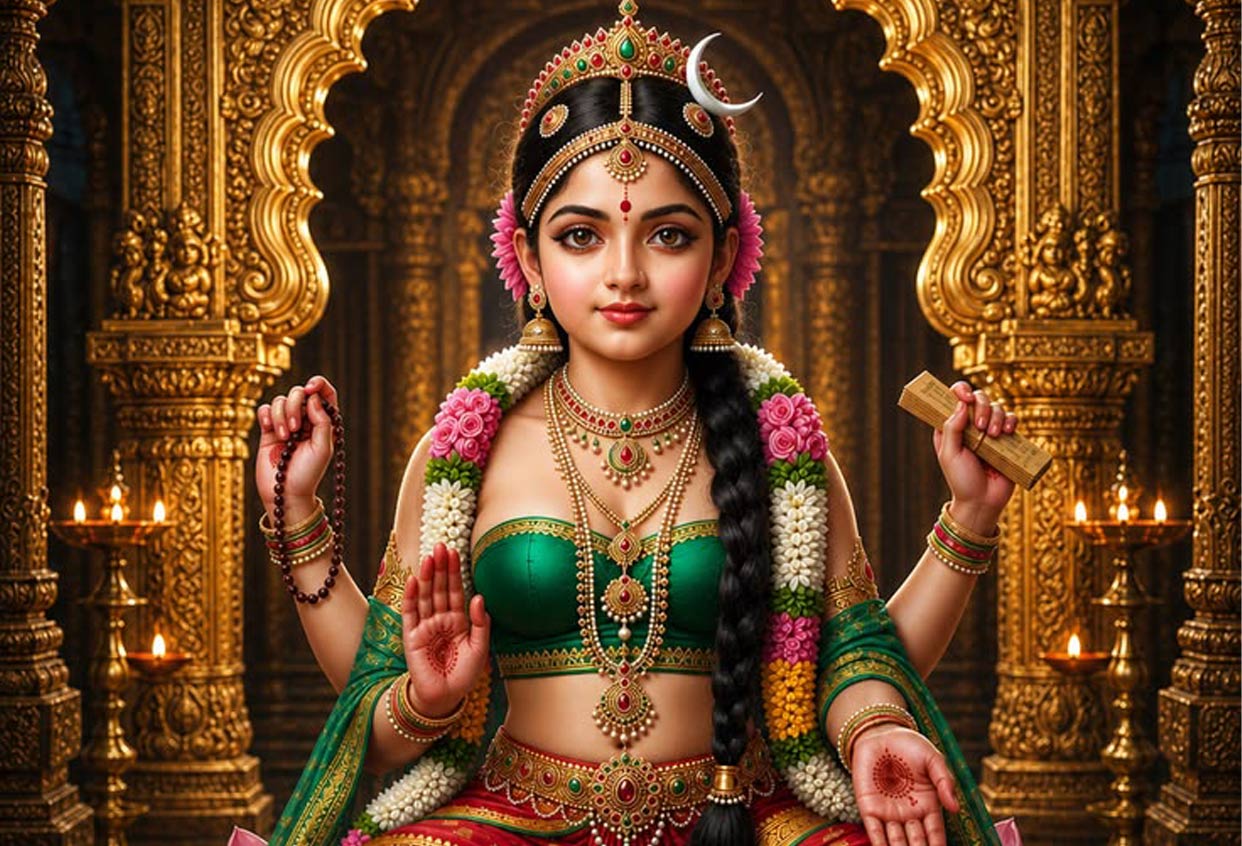
Sri Matre Namah
Before the mind attempts to understand the Divine Mother, it must first learn to bow before Her mystery.
Before the intellect begins to analyse Her names, forms, mantras and symbols, the heart must approach Her with humility.
For the Divine Mother is not merely a subject of study.
She is the very power through which knowledge becomes possible.
She is the consciousness behind thought.
She is the power behind creation.
She is the beauty that shines through existence.
She is the compassion that sustains life.
She is the wisdom that leads the seeker from ignorance toward realization.
Among the countless manifestations through which the Supreme Shakti is contemplated, the form of Sri Bala Tripura Sundari possesses a particularly intimate and profound significance.
She appears as Bala the Divine Child.
Yet She is not merely a child.
Within that youthful form is contemplated the immeasurable power of the Supreme Mother.
Her appearance speaks of innocence, but Her nature is wisdom.
Her form is youthful, but Her consciousness is eternal.
Her presence is tender, but Her Shakti is limitless.
Her beauty attracts the heart, but Her wisdom ultimately leads the seeker beyond beauty itself.
This apparent paradox is one of the great spiritual mysteries of Bala worship.
How can the Supreme appear as a child?
How can the source of the universe be represented in a youthful form?
Why does the Sri Vidya tradition give such importance to this manifestation?
To contemplate these questions is to begin a deeper journey into the meaning of Bala Swarupa.
1. The Meaning of Bala Tripura Sundari
The name itself is a profound teaching.
Bala signifies the youthful or child form.
Tripura is a name carrying multiple layers of theological and philosophical meaning.
Sundari means the Beautiful One.
Thus, Sri Bala Tripura Sundari may be contemplated as the youthful manifestation of the Divine Mother whose beauty is not merely physical but spiritual, cosmic and transcendental.
In Sri Vidya traditions, Tripura Sundari occupies a central place in the worship of the Divine Mother. The Lalitopakhyana associated with the Brahmanda Purana provides an important Puranic framework for Lalita Tripura Sundari, while the Tripura Rahasya presents Tripura through a deeply philosophical vision connected with consciousness and liberation.
The word Sundari therefore deserves special attention.
Ordinary beauty belongs to the changing world.
A flower blooms and fades.
A youthful face changes with time.
Physical forms appear, develop and disappear.
But the beauty represented by Tripura Sundari points toward a deeper reality.
It is the beauty of consciousness.
It is the beauty of harmony.
It is the beauty of existence itself.
It is the beauty perceived when the mind becomes quiet and the heart becomes pure.
2. Bala Swarupa - The Divine Child
The Sanskrit word Swarupa refers to essential nature or true form.
Therefore, when devotees contemplate the Bala Swarupa, they are not merely contemplating the physical appearance of a young Goddess.
They are contemplating what the child-form signifies spiritually.
A child is traditionally associated with innocence.
A child does not carry the elaborate psychological identity that adults construct around themselves.
There is spontaneity.
There is openness.
There is wonder.
There is directness.
There is natural joy.
In the Divine Bala form, these qualities acquire a higher spiritual meaning.
Bala does not represent ignorance.
Bala represents purity untouched by ego.
This distinction is essential.
An ordinary child gradually grows into worldly knowledge.
The Divine Child represents the consciousness that is already complete.
The childlike form therefore becomes a symbol of something eternal rather than something immature.
3. Why Does the Supreme Appear as a Child?
This question takes us directly into the mystery of Divine manifestation.
Human beings naturally associate power with physical strength, age, authority and grandeur.
We expect the powerful to appear formidable.
We expect the wise to appear old.
We expect the ruler to appear majestic.
The Divine does not have to follow these human expectations.
The Supreme can appear in any form.
The Infinite can reveal itself through the apparently small.
The immeasurable can shine through the intimate.
The cosmic can appear as the personal.
The Divine Child therefore teaches a profound lesson:
True power does not require an intimidating form.
Bala does not need to demonstrate power in order to possess it.
Her Shakti is inherent.
Her divinity is not created by external appearance.
The child-form itself becomes a revelation of the freedom of the Divine.
4. The Child as a Symbol of Pure Consciousness
Human consciousness becomes covered by layers of conditioning.
From childhood onward, the mind accumulates impressions.
Family creates one identity.
Society creates another.
Education creates another.
Success creates another.
Failure creates another.
Memory creates another.
Desire creates another.
Eventually, a person begins to mistake these accumulated identities for the Self.
Spiritual inquiry begins when this identification is questioned.
Who am I beneath all these changing identities?
Who am I before the mind creates its stories?
Who is aware of happiness?
Who is aware of sorrow?
Who observes waking, dreaming and deep sleep?
These questions lead toward the heart of contemplative philosophy.
The Tripura Rahasya is particularly significant here because it presents Tripura in relation to the underlying consciousness associated with the three states of waking, dream and deep sleep.
From this perspective, Bala Swarupa can become a contemplative symbol for consciousness before the complications of ego obscure its natural radiance.
5. The Innocence of Bala
The word innocence is often misunderstood.
Spiritual innocence does not mean lack of intelligence.
It does not mean inability to distinguish right from wrong.
It does not mean escaping responsibility.
Spiritual innocence means freedom from unnecessary inner distortion.
A pure heart does not constantly calculate.
It does not approach every relationship as an exchange.
It does not turn devotion into a business transaction.
It does not ask:
"What will I receive?"
Instead, it learns to say:
"Mother, let me offer myself."
This is the innocence represented by Bala.
The devotee approaches the Divine with simplicity.
Not because the devotee lacks knowledge, but because the devotee has learned that the deepest truths cannot be possessed by the ego.
6. Bala and the Mother
There is a beautiful paradox in the worship of Bala Tripura Sundari.
She is the Divine Mother.
Yet She appears as a child.
The devotee therefore encounters a form that is simultaneously tender and powerful.
This creates an especially intimate dimension of Bhakti.
The Mother is not distant.
She is approachable.
She is not merely a cosmic principle.
She is experienced as a living Divine presence.
She can be loved.
She can be worshipped.
She can be remembered.
She can be approached through prayer.
She can be contemplated through meditation.
This intimacy is one of the great strengths of Shakta devotion.
The Divine is not merely an abstract philosophical proposition.
The Divine becomes relationship.
7. The Threefold Mystery of Tripura
The word Tripura is central to understanding the Goddess.
Tri means three.
Pura is associated with cities, realms or dwelling places.
Different traditions and interpretations illuminate this name in different ways.
One important philosophical interpretation connects Tripura with the three states of ordinary consciousness:
Jagrat - waking
Svapna - dreaming
Sushupti - deep sleep
Every human being moves through these states.
We experience the waking world.
We experience dreams.
We enter deep sleep.
Yet something deeper than any one state is required for these states to be known.
The waking state changes.
The dream state changes.
Deep sleep comes and goes.
The witnessing consciousness is contemplated as deeper than these changing conditions.
This is one of the profound philosophical dimensions associated with Tripura.
The Goddess is not merely confined to one state.
She is contemplated as the consciousness underlying and transcending the three.
8. Tripura and the Inner Universe
The human being carries an entire universe within consciousness.
Thoughts appear.
Memories appear.
Emotions appear.
Images appear.
Dreams appear.
Sensations appear.
All these experiences change.
Yet awareness remains the field in which they appear.
This provides a powerful contemplative analogy.
The world appears within consciousness just as images appear within a mirror.
The mirror does not become damaged by the image reflected within it.
Similarly, consciousness remains the underlying reality while experiences continuously arise and disappear.
The philosophical vision associated with Tripura invites the seeker to contemplate this relationship between consciousness and manifestation.
Thus, Tripura Sundari is not merely the Goddess who rules a cosmic world somewhere outside.
She can also be contemplated as the Divine Consciousness within which the experience of the world appears.
9. Sundari - Beauty Beyond Form
Why is the Mother called Sundari?
Because She is beauty itself.
But spiritual beauty is not measured by human standards.
The beauty of the Divine Mother is the beauty of perfect consciousness.
It is the beauty that emerges when the mind is free from hatred.
It is the beauty of compassion.
It is the beauty of wisdom.
It is the beauty of selflessness.
It is the beauty of surrender.
When a devotee looks upon the form of Bala Tripura Sundari, the purpose is not simply to admire an attractive image.
The form should awaken contemplation.
What is true beauty?
What remains when physical beauty disappears?
What is beautiful about a compassionate heart?
What is beautiful about wisdom?
What is beautiful about silence?
These questions transform visual worship into spiritual reflection.
10. Bala as Vidya
The word Vidya means knowledge.
Within Sri Vidya, this word acquires an especially profound significance.
Knowledge is not merely information.
A person may possess enormous amounts of information and still remain inwardly restless.
True spiritual knowledge changes the knower.
It removes ignorance.
It weakens ego.
It reveals the impermanent nature of worldly attachments.
It directs attention toward the eternal.
It ultimately becomes self-knowledge.
The Divine Mother is therefore contemplated as the source of Vidya.
Bala is not merely a form that receives wisdom.
She is revered within the Sri Vidya vision as an expression of the very power of sacred knowledge.
11. The Mother as Guru
The Guru traditionally leads the seeker from darkness toward light.
In the deepest sense, Divine Mother worship can also be understood as a journey in which the Goddess herself becomes the inner guide.
The Mother teaches through scripture.
She teaches through experience.
She teaches through joy.
She teaches through suffering.
She teaches through silence.
She teaches through the unexpected events of life.
A sincere devotee gradually discovers that spiritual instruction does not always arrive in the form of spoken words.
Sometimes an experience itself becomes the teaching.
Sometimes a difficulty becomes the teacher.
Sometimes silence becomes the scripture.
And sometimes devotion itself becomes knowledge.
12. Bala and the Sri Vidya Tradition
Sri Vidya represents a highly developed Shakta spiritual tradition in which devotion, sacred symbolism, mantra, yantra, meditation and philosophical inquiry are woven together.
The Divine Mother is not approached merely as a deity who grants worldly prosperity.
She is approached as the Supreme Reality itself.
The Sri Chakra is one of the most important sacred symbols associated with this tradition.
Its structure invites contemplation of the relationship between unity and multiplicity.
The outer levels represent the complexity of manifestation.
The inward movement represents spiritual return.
The center the Bindu becomes a symbol of supreme unity.
The seeker moves from the many toward the One.
From external perception toward inner awareness.
From restless thought toward stillness.
From identification toward realization.
13. The Bindu The Center of the Sacred
A point appears to be almost nothing.
Yet the Bindu carries immense symbolic significance.
From the point, the entire sacred geometry can be contemplated.
The One appears as many.
The unmanifest becomes manifest.
The infinite expresses itself through finite forms.
And the many ultimately return to unity.
This is one reason the Sri Chakra is not merely a diagram.
It is a map of contemplation.
The devotee may begin at the outer world.
Gradually attention becomes inward.
The mind becomes subtle.
The multiplicity of experience is recognized.
Finally, attention turns toward the center.
The spiritual journey is not merely movement through space.
It is movement through consciousness.
14. Bala and the Cosmic Mother
The child-form should never be mistaken for limitation.
The Divine Mother is not reduced by appearing as Bala.
The infinite can express itself through a finite form without becoming finite.
The ocean can be represented by a drop without becoming the drop.
The sun can be reflected in a small vessel without losing its vastness.
Likewise, the Divine can be approached through an image while remaining beyond every image.
This is the secret of sacred form.
The form is a doorway.
It is not the final boundary of the Divine.
15. Bala as Divine Play
The concept of Lila, Divine play, is deeply meaningful in devotional philosophy.
Creation may be contemplated not merely as a mechanical process but as the expression of Divine Shakti.
The universe continuously changes.
Forms appear and disappear.
Relationships arise.
Lives unfold.
The seasons change.
Birth leads to growth.
Growth leads to decline.
Decline leads to dissolution.
Yet beneath this constant movement lies the mystery of consciousness.
The Bala form naturally evokes the quality of play.
A child plays without constantly calculating the final result.
Similarly, Divine Lila points toward an existence that is not limited by the ego's demand for control.
16. The Battle Within
The Divine Mother is often remembered through powerful stories of cosmic conflict.
But the spiritual seeker should not stop at the external story.
Every sacred battle can also become an inner teaching.
There is an enemy within every seeker:
anger.
greed.
jealousy.
fear.
pride.
attachment.
ignorance.
ego.
The real spiritual battle is the transformation of these tendencies.
When the devotee invokes the Mother, the prayer is therefore not merely:
"Remove my external problems."
It can become:
"Mother, remove the darkness within me."
That is a far deeper prayer.
17. Bala and the Transformation of the Mind
The mind is powerful.
It can become a prison.
It can also become a temple.
When dominated by desire, it constantly moves outward.
When purified through devotion and knowledge, it becomes capable of reflection.
The Divine Mother becomes the center around which the mind can become steady.
Instead of endlessly following thoughts, the devotee remembers the Goddess.
Instead of constantly pursuing external objects, the devotee turns toward the sacred.
Instead of asking what the world can provide, the devotee asks what can be offered to the Divine.
This transformation is itself a form of spiritual grace.
18. The Sreemadam Sri Balapeedam Perspective
Within the devotional atmosphere of Sreemadam Sri Balapeedam, the Divine Mother is approached not merely as a philosophical concept but as a sacred presence worthy of loving worship and remembrance.
The name "Balapeedam" itself evokes the tenderness and sacredness associated with Bala.
For devotees, the Peedam becomes a place where spiritual remembrance takes visible form through worship, prayer, sacred observances and community devotion.
Such traditions should be understood as living expressions of faith.
A sacred place is not merely a structure.
It is a place where generations gather their attention toward the Divine.
It is a place where prayer becomes collective.
It is a place where the heart learns remembrance.
And it is a place where the ancient relationship between devotee and Divine Mother continues into the present.
19. Bala in the Modern Age
The modern world has achieved extraordinary material progress.
Humanity can communicate across continents in seconds.
Knowledge can be accessed almost instantly.
Technology has transformed everyday life.
Yet the fundamental questions remain unchanged.
Who am I?
Why do I suffer?
What is lasting?
What is true happiness?
What lies beyond fear?
What is the purpose of human life?
These questions make the wisdom of the Divine Mother relevant even today.
Bala Swarupa reminds the modern seeker that spiritual life does not require complexity at every stage.
Sometimes it begins with something simple:
A sincere prayer.
A moment of silence.
A lamp before the Mother.
A remembrance of Her name.
A compassionate act.
A heart that says:
"Amma, guide me."
20. The Childlike Heart of the Seeker
To approach Bala Tripura Sundari is to learn the value of a childlike heart.
Not childishness.
Not ignorance.
But openness.
A child asks questions without embarrassment.
A seeker must also ask.
A child can experience wonder.
A seeker must rediscover wonder.
A child can forgive quickly.
A seeker must learn forgiveness.
A child can approach the mother without calculation.
A devotee must learn surrender.
Thus Bala does not ask us to become less intelligent.
She asks us to become less burdened by ego.
21. From Devotion to Knowledge
The spiritual journey may begin with form.
The devotee sees the Goddess.
The devotee offers flowers.
The devotee lights a lamp.
The devotee chants.
The devotee prays.
But gradually something deeper happens.
The external Mother becomes an internal presence.
The prayer becomes meditation.
Meditation becomes contemplation.
Contemplation becomes inquiry.
Inquiry becomes knowledge.
Knowledge becomes silence.
And silence reveals what was always present.
This is the movement from devotion toward realization.
22. The Mother Within
A great spiritual question eventually arises:
Where is the Divine Mother?
Is She only in the temple?
Is She only in the image?
Is She only in sacred texts?
Or does She also shine within consciousness itself?
Sri Vidya's philosophical dimensions invite precisely this inward movement.
The external form provides support for meditation.
The inner contemplation reveals subtler dimensions.
The ultimate spiritual understanding is not that the Divine is merely somewhere else.
The Divine is the very consciousness through which the seeker experiences existence.
Thus the Mother outside becomes the Mother within.
23. The Meaning of Surrender
Surrender is often misunderstood as weakness.
It is not.
Surrender means releasing the illusion that the ego must control everything.
A devotee still acts.
A devotee still works.
A devotee still fulfills responsibilities.
But the inner attitude changes.
Instead of:
"I alone am the doer."
The heart learns:
"May my actions become an offering."
Instead of:
"Everything must happen according to my desire."
The devotee learns:
"Mother, let me accept Your wisdom."
This surrender creates inner freedom.
24. Bala as Compassion
The Divine Child is also a symbol of tenderness.
The Mother sees the seeker not merely as a sinner or a failure.
She sees the possibility of transformation.
This is why devotion can give hope.
A person may have made mistakes.
A person may have fallen.
A person may have become lost.
But the path back toward the Divine is never closed.
The Mother waits.
The heart can return.
Prayer can begin again.
Devotion can begin again.
Life can begin again.
25. The Great Mystery of the Divine Child
Perhaps the deepest mystery of Bala Swarupa is that the form appears simple while the philosophy behind it is profound.
A child stands before the devotee.
But behind that form is the mystery of Shakti.
Behind Shakti is consciousness.
Behind consciousness lies the question of Reality itself.
The seeker begins with a beautiful form.
The journey eventually becomes a search for the source of beauty.
The seeker begins by worshipping the Mother.
The journey eventually becomes an inquiry into the nature of the Self.
The seeker begins outside.
The journey ends within.
26. A Contemplation on Bala Swarupa
Sit quietly before the image of Sri Bala Tripura Sundari.
Do not immediately ask for anything.
Simply look.
Observe the form.
Observe the beauty.
Observe the peacefulness.
Then close the eyes.
Remember the Mother.
Allow the mind to become quiet.
If thoughts arise, let them arise.
If emotions arise, let them arise.
Do not fight them.
Return gently to the remembrance of Bala.
Then ask within:
What is this awareness in which every thought appears?
Remain quietly with the question.
This is where devotion begins to open into contemplation.
27. The First Teaching of Bala
If the entire first part of this journey had to be reduced to one teaching, it would be this:
Return to purity.
Not purity as social judgment.
Not purity as superiority.
But purity of intention.
Purity of heart.
Purity of devotion.
Purity of awareness.
The devotee who approaches the Mother without selfish calculation has already taken a significant step toward spiritual transformation.
28. The Mother Beyond Names and Forms
Every name is a doorway.
Every form is a doorway.
But the Divine is beyond all names and forms.
Bala Tripura Sundari is worshipped through a sacred form.
Yet the Reality represented by that form cannot be confined to the image.
This is the beauty of Hindu sacred symbolism.
The devotee does not have to choose between form and formlessness.
Form can lead toward the formless.
Name can lead toward silence.
Image can lead toward meditation.
Devotion can lead toward knowledge.
The Mother can lead the seeker beyond the limitations of the mind.
29. The Eternal Child
Everything in the physical world changes.
Children grow.
Youth becomes maturity.
Bodies age.
Civilizations rise and fall.
Generations pass.
But the Divine Child remains eternally youthful in sacred contemplation.
This eternal youth can be understood as a symbol of consciousness untouched by time.
The body changes.
Awareness witnesses change.
The world changes.
Awareness witnesses change.
Thoughts change.
Awareness witnesses change.
The eternal Bala therefore becomes a beautiful symbol of that which is not exhausted by time.
30. What Bala Tripura Sundari Teaches Humanity
Her form teaches innocence.
Her beauty teaches harmony.
Her Shakti teaches strength.
Her wisdom teaches knowledge.
Her motherhood teaches compassion.
Her childlike nature teaches simplicity.
Her connection with Tripura points toward consciousness.
Her place within Sri Vidya points toward spiritual transformation.
Her worship invites devotion.
Her philosophy invites inquiry.
Her presence invites surrender.
And her ultimate teaching leads beyond all of these toward the mystery of the Self.
31. A Prayer from the Heart
O Sri Bala Tripura Sundari,
Radiant Mother of the threefold universe,
Eternal Child of Supreme Shakti,
Light of wisdom,
Source of compassion,
Beauty beyond comparison,
Purity beyond description,
May our hearts become worthy of remembering You.
When pride rises within us,
teach us humility.
When fear arises,
give us courage.
When confusion arises,
give us wisdom.
When anger arises,
give us compassion.
When attachment binds us,
give us freedom.
When our minds become restless,
draw them toward Your feet.
When we forget the Divine,
remind us.
When we become lost in the outer world,
lead us inward.
May our knowledge become devotion.
May our devotion become wisdom.
May our wisdom become realization.
May our lives become an offering.
Sri Bala Tripura Sundaryai Namah.
Conclusion
The journey into the world of Sri Bala Tripura Sundari begins not with a complicated doctrine but with a simple and beautiful image:
The Divine Mother appearing as a child.
Yet within that simplicity lies an extraordinary spiritual depth.
Bala is innocence without ignorance.
Bala is beauty without attachment.
Bala is power without aggression.
Bala is knowledge without pride.
Bala is tenderness without weakness.
Bala is the Divine appearing in an intimate form so that the human heart can approach the Infinite without fear.
The name Tripura opens another dimension.
The Goddess is contemplated not merely as an external figure but through the mystery of the threefold experience and the consciousness that underlies it. The Tripura Rahasya is particularly important for this philosophical perspective, presenting Tripura in connection with consciousness and the states of waking, dreaming and deep sleep.
The Sri Vidya tradition takes this contemplation still deeper.
The form becomes symbol.
The symbol becomes meditation.
Meditation becomes inquiry.
Inquiry becomes knowledge.
And knowledge ultimately points toward the Reality that cannot be confined by any name or form.
For the devotee of Sreemadam Sri Balapeedam, the contemplation of Bala Tripura Sundari can therefore become both intimate and profound.
She is the Divine Mother.
She is the beloved Bala.
She is the source of Vidya.
She is the radiance of Shakti.
She is the beauty that draws the heart inward.
She is the wisdom that dissolves ignorance.
And she is the sacred presence before whom the seeker can simply bow and say:
"Amma, lead me from ignorance to knowledge, from restlessness to peace, and from the outer appearance of life to the eternal Truth within."
The first doorway has now opened.
The next stage of our journey will take us deeper into the meaning of Tripura Sundari herself the mystery of the threefold reality, the symbolism of the Divine Mother's form, the Sri Chakra, the Bindu, Her sacred attributes, and the philosophical vision concealed within the iconography of the Goddess.
The journey from Bala Swarupa to Tripura Sundari is not a journey from one deity to another.
It is a journey from the visible form toward the invisible Reality.
And that journey has only begun.