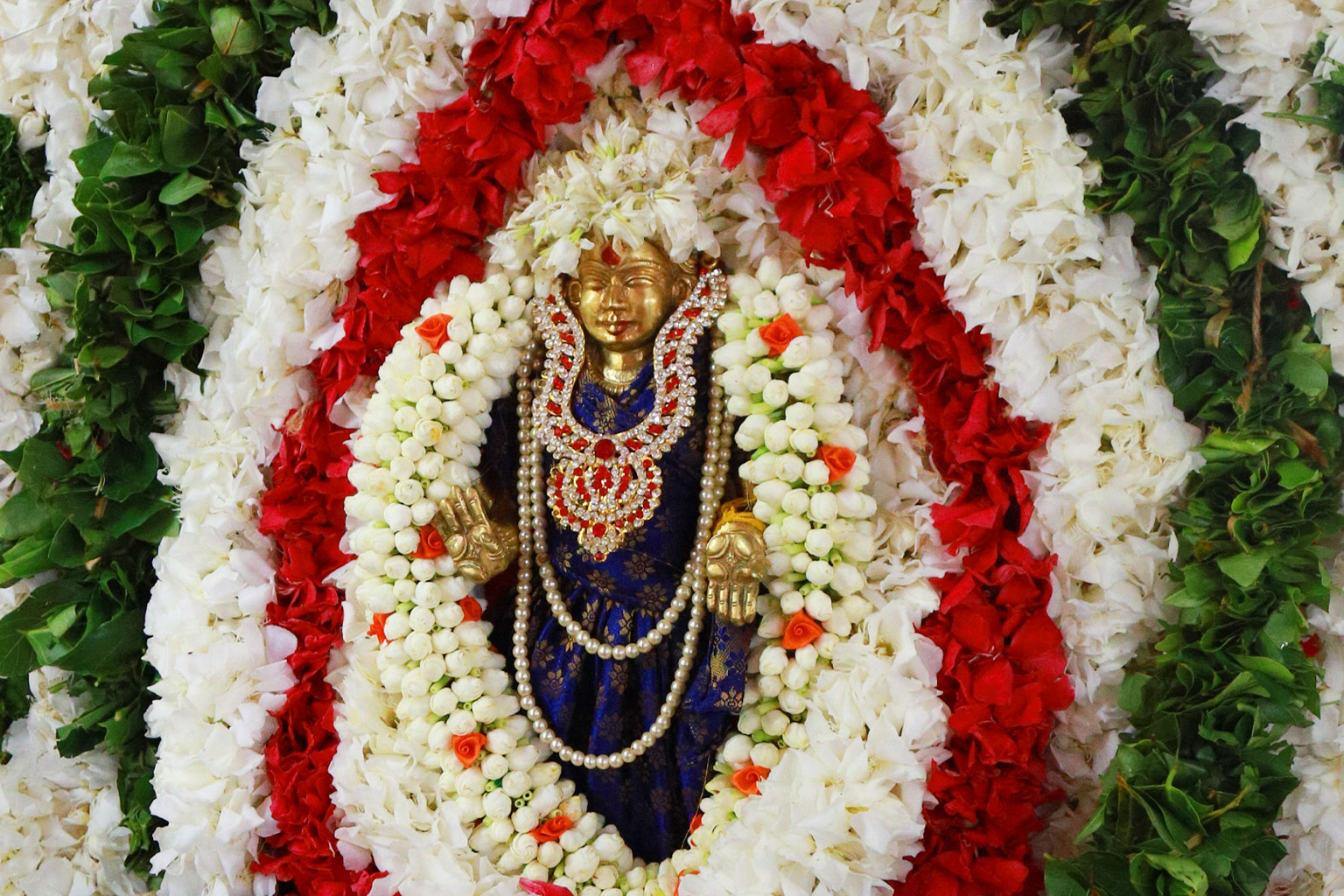
Invocation
Sri Matre Namah.
The Divine Mother cannot be confined to a single form.
She is the stillness behind meditation.
She is the power behind creation.
She is the wisdom behind knowledge.
She is the beauty behind all that is beautiful.
She is the compassion that moves the heart toward another being.
And in the Sri Vidya tradition, this immeasurable Divine Reality is contemplated through the magnificent form of Sri Tripura Sundari.
In Part 1, we contemplated the mystery of Bala Swarupa the Divine Mother appearing in the eternal form of a child.
In this second part, our contemplation moves deeper.
We ask:
What does Tripura mean?
Why is the Divine Mother called Tripura Sundari?
What is the meaning of Her extraordinary beauty?
Why is Her form associated with the Sri Chakra?
What do the sugarcane bow, flower arrows, noose and goad signify?
Why is the Bindu so important?
And how can the contemplation of a sacred form ultimately lead the seeker toward the formless?
These are not merely questions of iconography.
They are questions of consciousness.
The Meaning of Tripura Sundari
The name Tripura Sundari is itself a profound spiritual teaching.
Tripura is commonly understood through the symbolism of the "three cities" or threefold realms.
Sundari means the Beautiful One.
Together, the name points toward the Divine Mother as the supreme beauty underlying the threefold universe.
The threefold symbolism can be contemplated in different ways.
It may be associated with:
- waking, dream and deep sleep;
- the three worlds;
- the three gunas;
- the three fundamental functions of manifestation;
- the three dimensions of experience.
Different Sri Vidya and Shakta texts and lineages emphasize different interpretations.
The important principle is that the Mother transcends the divisions through which ordinary consciousness experiences reality.
She is not merely one part of the three.
She is the consciousness in which the threefold experience appears.
The Three States of Consciousness
Every human being experiences three familiar states:
Jagrat waking
Svapna dream
Sushupti deep sleep
In waking, the external world appears.
In dream, an internal world appears.
In deep sleep, neither the ordinary external nor dream world is consciously experienced.
Yet after waking, a person says:
"I slept well."
This raises a profound question.
Who knows that sleep occurred?
What is the underlying principle because of which the changing states are experienced?
The contemplation of Tripura invites the seeker to look beyond the changing states toward the consciousness that underlies them.
Thus, Tripura becomes more than mythology.
It becomes a doorway to self-inquiry.
Beyond the Three States
If the Divine Mother is contemplated as transcending the three states, then She cannot be reduced to waking consciousness.
She is not merely dream consciousness.
She is not merely the absence of experience found in deep sleep.
She is the Reality underlying all three.
This is where the philosophical depth of Tripura worship becomes apparent.
The seeker begins by worshipping a form.
Then the seeker contemplates the meaning of that form.
Eventually, the mind is directed toward the consciousness in which all forms arise.
The external deity becomes an inward meditation.
Sundari The Beauty Beyond Beauty
What is beauty?
The ordinary mind answers through appearance.
A beautiful flower.
A beautiful face.
A beautiful landscape.
A beautiful melody.
But all such beauty is subject to time.
Flowers fade.
Faces change.
Landscapes transform.
Melodies end.
The beauty of Tripura Sundari points toward something deeper.
It is the beauty of harmony.
The beauty of consciousness.
The beauty of Truth.
The beauty experienced when the mind becomes peaceful.
The beauty discovered when separation begins to dissolve.
Thus, Sundari is not merely an aesthetic description.
It is a philosophical statement.
The Supreme Reality is experienced as fullness, harmony and perfection.
Divine Beauty and Divine Consciousness
In Sri Vidya contemplation, beauty and consciousness are not necessarily treated as unrelated concepts.
The world is experienced through consciousness.
Without consciousness, beauty cannot be known.
A flower may exist physically, but the experience of its beauty requires awareness.
Therefore, the Mother as supreme beauty can be contemplated as the very consciousness through which beauty becomes meaningful.
The devotee sees the flower.
The devotee experiences beauty.
Then the devotee asks:
Who is the one experiencing beauty?
This question begins the inward journey.
The Radiant Form of the Goddess
Sri Tripura Sundari is traditionally represented through an iconography filled with symbolism.
Her form is not merely artistic.
Every attribute can become a meditation.
Her youthful appearance.
Her radiant complexion.
Her ornaments.
Her throne.
Her four arms.
Her sugarcane bow.
Her flower arrows.
Her noose.
Her goad.
Her association with Sri Chakra.
Together, these symbols communicate an entire spiritual philosophy.
The form teaches.
The symbol teaches.
The beauty teaches.
And the devotee learns to see the Divine not merely as an object but as a sacred language.
The Four Arms
The four arms of the Goddess are traditionally understood through several symbolic interpretations.
They indicate Divine capacity and sovereignty.
The hands hold four significant objects:
Pasha the noose
Ankusha the goad
Ikshu Dhanus the sugarcane bow
Pushpa Bana the flower arrows
Each has a profound psychological and spiritual meaning.
The Mother holds the instruments of attraction, restraint, direction and transformation.
The entire human mind can be understood through these principles.
We are attracted.
We become attached.
We resist.
We desire.
We pursue.
We suffer.
The Goddess reveals the forces governing this movement and offers a path toward liberation.
The Sugarcane Bow
The sugarcane bow is one of the most beautiful symbols associated with Tripura Sundari.
Sugarcane is sweet.
The bow therefore naturally evokes sweetness.
But the symbolism goes deeper.
The mind itself can become the instrument through which desire is projected into the world.
A thought becomes a desire.
Desire becomes action.
Action creates experience.
Experience creates further impressions.
The cycle continues.
The sugarcane bow can therefore be contemplated as a symbol connected with the mind and desire.
The Mother holds that power.
This teaches the seeker that desire itself is not outside the field of spiritual understanding.
It must be understood.
The Five Flower Arrows
The Goddess is traditionally depicted holding five flower arrows.
These are associated in different interpretations with the powers through which sensory experience operates.
The flowers are delicate.
The arrows are subtle.
Yet their effect can be powerful.
A sensory impression can change an entire state of mind.
A fragrance can awaken memory.
A sound can create emotion.
A sight can generate attraction.
A touch can create longing.
Thus, the flower arrows beautifully represent the subtle power of the senses and their impressions.
The Mother holds these powers.
The seeker learns not to become their prisoner.
The Pasha The Noose
The Pasha is generally represented as a noose or rope.
At the ordinary level, the noose symbolizes bondage.
Human beings become bound by:
- attachment,
- desire,
- fear,
- memory,
- identity,
- possessions,
- relationships,
- expectations.
But the same symbol can also be contemplated as Divine attraction.
The Mother draws the devotee toward Herself.
Thus, the Pasha possesses a beautiful dual significance.
The world binds.
The Divine also draws.
The difference lies in the direction of the movement.
Attachment pulls consciousness outward.
Grace draws consciousness inward.
The Ankusha The Goad
The Ankusha is traditionally understood as an elephant goad.
It represents direction, discipline and correction.
A spiritual seeker may possess devotion yet still become distracted.
The mind wanders.
The senses pursue external objects.
Desire creates confusion.
At such moments, discipline becomes necessary.
The goad represents the Divine force that redirects the seeker.
Sometimes grace appears as comfort.
Sometimes grace appears as correction.
Sometimes the Mother gives what the devotee desires.
At other times, She removes what the devotee believes is necessary.
Both can become forms of grace.
The Bow, Arrows, Noose and Goad
Together, the four attributes form a profound psychological map.
The bow represents the mind.
The arrows represent sensory forces and their projections.
The noose represents attraction and attachment.
The goad represents restraint and direction.
The seeker who understands these symbols begins to understand the human mind itself.
Sri Vidya therefore transforms iconography into meditation.
The Goddess is not merely holding objects.
She is revealing the structure of experience.
The Red Radiance of the Mother
Tripura Sundari is traditionally associated with a radiant reddish or coral-like complexion.
This color carries multiple layers of symbolism.
Red is associated with:
- energy,
- life,
- passion,
- manifestation,
- Shakti,
- creative power.
The Divine Mother is not represented as distant from creation.
She is intimately present within it.
The world is dynamic.
Life moves.
Creation unfolds.
Desire arises.
Action occurs.
Shakti is therefore experienced as movement itself.
The radiant color of the Goddess becomes a visual meditation upon this living cosmic energy.
Beauty and Shakti
The greatest misunderstanding of Divine beauty would be to reduce it to physical attractiveness.
Shakti is not merely beautiful because She appears beautiful.
She is beautiful because She is fullness.
The spiritual seeker eventually discovers that true beauty is associated with harmony between consciousness and existence.
When the mind is disturbed, even beauty can become a source of attachment.
When the mind is purified, beauty becomes a reminder of the Divine.
Thus, the same world can bind one person and liberate another.
The difference lies in consciousness.
The Sri Chakra
No serious contemplation of Tripura Sundari can remain separate from the Sri Chakra.
The Sri Chakra is one of the central sacred symbols of Sri Vidya.
Its intricate geometry contains multiple levels of symbolism.
At its heart is the Bindu.
Around it are interpenetrating triangles and successive enclosures.
The Sri Chakra can be contemplated as:
- a sacred cosmogram,
- a representation of the Divine Mother,
- a map of manifestation,
- a map of consciousness,
- a symbolic journey from multiplicity toward unity.
It is both cosmic and inward.
The Outer World and the Inner Journey
Human consciousness ordinarily moves outward.
We see objects.
We pursue experiences.
We seek pleasure.
We avoid pain.
We construct identities.
The Sri Chakra presents another movement.
From the outer enclosures, consciousness moves toward the center.
This becomes a powerful metaphor for spiritual life.
The seeker gradually moves:
from distraction to concentration,
from desire to understanding,
from attachment to surrender,
from multiplicity to unity,
from outward seeking to inward realization.
The journey toward the Bindu becomes a symbolic journey toward the center of consciousness.
The Bindu
At the center of Sri Chakra is the Bindu.
A point.
Yet this point represents immeasurable fullness.
It is the center from which the entire sacred geometry is understood.
Philosophically, the Bindu can be contemplated as unity.
Before multiplicity, there is unity.
From unity arises manifestation.
The many appear.
Names and forms arise.
Yet the underlying Reality remains one.
The spiritual journey eventually reverses this movement.
The seeker moves from the many toward the One.
Bindu as the Heart of the Mother
The Bindu can be contemplated as the heart of Sri Chakra.
But its deeper significance is beyond physical location.
The heart becomes a symbol of the center of consciousness.
When the mind is scattered, awareness appears divided.
When the mind becomes still, awareness becomes centered.
The Bindu therefore becomes an invitation:
Return to the center.
Return from endless thought.
Return from endless desire.
Return from endless comparison.
Return to awareness.
The Mother and the Sri Chakra
The Sri Chakra is not merely a geometric diagram associated with the Goddess.
It is a sacred expression of Her cosmic nature.
She is both the transcendent center and the manifested universe.
She is the source.
She is the process.
She is the experience.
She is the destination.
This is one of the reasons Tripura Sundari occupies such an important place within Sri Vidya traditions.
The Goddess is not merely one deity among many in a superficial sense.
She is contemplated as the Supreme Shakti through whom consciousness and manifestation are understood.
The Sacred Throne
Traditional iconography places Tripura Sundari upon a divine throne.
The throne itself carries symbolic significance.
The Goddess is sovereign.
She is not governed by the forces of creation.
Rather, creation exists within Her power.
The imagery of the throne therefore expresses Divine sovereignty.
Yet Her sovereignty is not the sovereignty of a worldly ruler.
It is the sovereignty of consciousness over the apparent multiplicity of existence.
Shiva and Shakti
Sri Vidya theology cannot be understood without the relationship between Shiva and Shakti.
Shiva represents pure consciousness.
Shakti represents the dynamic power of manifestation.
Without consciousness, power has no ground.
Without Shakti, consciousness remains unexpressed in the manifest universe.
Their relationship is therefore not simply the relationship between two separate beings.
It expresses the inseparability of consciousness and its power.
Tripura Sundari is contemplated within this profound unity.
The Mother as Creator
Creation is often described in terms of beginning.
But from a non-dual perspective, creation is not necessarily a movement away from the Divine.
The Divine is present within manifestation.
Every form arises within consciousness.
Every experience arises within consciousness.
Every thought arises within consciousness.
The Mother therefore does not merely create a universe somewhere outside Herself.
The universe exists within the field of Divine Shakti.
This is a profound shift in spiritual perception.
The Mother as Preserver
Everything that exists must be sustained.
A body requires nourishment.
A relationship requires care.
A society requires cooperation.
A spiritual practice requires discipline.
The Divine Mother is therefore contemplated not only as the source of creation but also as its sustaining power.
Every moment of existence becomes an expression of Divine support.
The breath itself becomes sacred.
The Mother as Transformative Power
Nothing in the manifest universe remains unchanged.
Youth becomes age.
Day becomes night.
Birth leads toward death.
Pleasure becomes memory.
Forms arise and disappear.
Transformation is therefore an inherent aspect of existence.
The Mother is also contemplated as the power of transformation.
For the spiritual seeker, this transformation becomes inward.
Ignorance becomes understanding.
Attachment becomes surrender.
Fear becomes faith.
Ego becomes humility.
Knowledge becomes wisdom.
Tripura Sundari and the Human Mind
The Goddess's iconography can be read psychologically.
The mind is constantly moving.
The senses send information inward.
Desires arise.
Attachments form.
Fear appears.
Memory influences decisions.
The ego constructs identity.
The Divine Mother holds the symbols representing these forces.
This teaches the seeker that spirituality is not an escape from the mind.
It is the understanding of the mind.
Beauty as a Spiritual Discipline
To see beauty without becoming attached to it is itself a spiritual discipline.
A flower can be admired without possession.
A beautiful person can be respected without objectification.
A successful life can be appreciated without envy.
A sacred image can be worshipped without reducing it to material appearance.
This is the higher meaning of Sundari.
Beauty becomes sacred when it reveals the Divine rather than strengthening attachment.
The Divine Child and the Divine Queen
Bala and Tripura Sundari reveal two complementary dimensions.
Bala evokes:
- innocence,
- intimacy,
- playfulness,
- purity,
- tenderness.
Tripura Sundari evokes:
- sovereignty,
- wisdom,
- cosmic beauty,
- Divine power,
- supreme consciousness.
These are not contradictory.
The Divine Mother can be infinitely tender and infinitely powerful.
She can be the beloved child and the sovereign of the universe.
This is the mystery of Shakti.
From Symbol to Meditation
A symbol becomes spiritually meaningful only when it changes the mind.
When the devotee sees the sugarcane bow, let it become a reminder to understand desire.
When the devotee sees the flower arrows, let them become a reminder to understand the senses.
When the devotee sees the noose, let it become a reminder of attachment.
When the devotee sees the goad, let it become a reminder of discipline.
When the devotee sees the Sri Chakra, let it become a reminder to return to the center.
Then iconography becomes meditation.
The Sacred Beauty of Simplicity
Despite the profound philosophy surrounding Tripura Sundari, the devotee need not approach Her with intellectual complexity alone.
The heart can simply say:
"Mother, guide me."
That prayer contains immense spiritual depth.
The seeker need not know every philosophical term before beginning devotion.
Sincerity is itself a form of knowledge.
Humility opens doors that intellectual pride cannot.
Bala Tripura Sundari and Sreemadam Sri Balapeedam
Within the devotional setting of Sreemadam Sri Balapeedam, the contemplation of Bala Tripura Sundari can be experienced as a living spiritual relationship.
The Mother is approached with reverence.
Her presence becomes a focus for prayer.
Her form becomes a focus for meditation.
Her grace becomes a source of strength.
Her symbolism becomes a guide for inner transformation.
The sacred environment encourages the devotee to move beyond merely seeing the Goddess and toward experiencing the Divine Mother as an intimate spiritual reality.
This is the essence of devotional worship.
The Three Worlds Within
The phrase "three worlds" need not be understood only cosmologically.
The human being also contains multiple dimensions of experience.
Body.
Mind.
Awareness.
The external world.
The internal world.
The world of deep rest.
The spiritual seeker gradually discovers that all these dimensions are known within consciousness.
Thus, Tripura becomes both cosmic and personal.
The three worlds are outside.
The three worlds are also within.
And the Mother transcends them all.
The Journey Toward the Center
The deepest teaching of this part of our journey can be expressed through one movement:
From the circumference to the center.
The world is the circumference.
The mind is another circumference.
Desire creates another circumference.
Identity creates another.
But beneath all these layers is the center.
The Bindu.
The silent awareness.
The Divine Mother.
The Self.
The journey toward Her is therefore simultaneously a journey toward oneself.
What Does the Mother Ask From the Seeker?
The Mother does not merely ask for external offerings.
The deepest offering is the ego.
Offer pride.
Offer fear.
Offer attachment.
Offer anger.
Offer selfish desire.
Offer the need to control everything.
Then devotion becomes transformation.
A flower placed before the Goddess is beautiful.
But a purified heart offered to Her is the greater offering.
The Inner Sri Chakra
The external Sri Chakra can be contemplated as sacred geometry.
The inner Sri Chakra is the purified consciousness of the seeker.
Every layer of distraction must gradually be crossed.
Every attachment must be understood.
Every fear must be faced.
Every false identity must be examined.
Finally, the seeker reaches the center.
There is no need to travel anywhere.
The center was always present.
Only the mind was moving away from it.
The Silent Beauty of Realization
When the mind becomes quiet, the Divine need not be imagined.
Reality becomes self-evident.
The seeker begins with a sacred form.
The form leads to contemplation.
Contemplation leads to stillness.
Stillness reveals awareness.
Awareness reveals the ground of experience.
This is why Sri Vidya can be both deeply devotional and profoundly philosophical.
The Mother is loved.
The Mother is contemplated.
The Mother is ultimately realized as the very consciousness through which love and contemplation are possible.
A Devotional Contemplation
Sit quietly before the image of Sri Bala Tripura Sundari.
Do not begin with complicated thought.
Simply look.
Observe the beauty.
Observe the tenderness.
Observe the radiance.
Then close your eyes.
Remember Her.
Let the form appear within the mind.
Then ask gently:
Where is the Mother?
Is She only in the image?
Is She only in the temple?
Or is the awareness through which I remember Her itself sacred?
Remain silent.
Let the question deepen.
The Radiance of Tripura
Tripura Sundari is called beautiful because She reveals the beauty hidden within existence.
She is the beauty of consciousness.
She is the beauty of harmony.
She is the beauty of wisdom.
She is the beauty of devotion.
She is the beauty of surrender.
She is the beauty that remains when the restless mind becomes still.
Her radiance is not merely something seen.
It is something awakened.
Conclusion The Mother at the Center
The journey of Part 2 began with a question:
Who is Tripura Sundari?
We discovered that Her name itself contains a universe of meaning.
Tripura points toward the threefold dimensions of experience.
Sundari points toward supreme beauty.
Her form reveals the subtle relationship between consciousness, desire, senses and spiritual discipline.
Her four sacred attributes become symbols of the human mind.
Her flower arrows reveal the subtle power of sensory experience.
Her sugarcane bow reminds us of the sweetness and force of desire.
Her noose reveals attachment and Divine attraction.
Her goad teaches direction and discipline.
The Sri Chakra reveals a sacred map from multiplicity toward unity.
And at its center shines the Bindu the silent point of infinite fullness.
The devotee begins at the outer form.
The seeker moves inward.
The mind becomes still.
The heart becomes pure.
And finally, the Mother is discovered not as something distant, but as the luminous Reality at the center of existence.
That is the deeper mystery of Sri Tripura Sundari.
She is the Beauty of the Three.
She is the One behind the many.
She is the Mother.
She is Shakti.
She is the radiant center.
And She is the silence toward which every sincere spiritual journey ultimately moves.
Sri Bala Tripura Sundaryai Namah.
Sri Lalitambikayai Namah.
Sri Matre Namah.
Preview of Part 3
The next chapter will enter the realm of Divine Leela.
We will explore the traditional sacred narratives associated with Sri Tripura Sundari, the manifestation of Divine Shakti, the battle against Bhandasura in the Lalita tradition, the deeper symbolism of the Divine Mother's victory, and how these cosmic narratives can be understood not merely as stories of gods and demons, but as profound descriptions of the inner battle between knowledge and ignorance, Divine consciousness and ego.
Part 3 - The Divine Leelas of Bala Tripura Sundari: The Child Goddess and the Triumph of Divine Shakti.