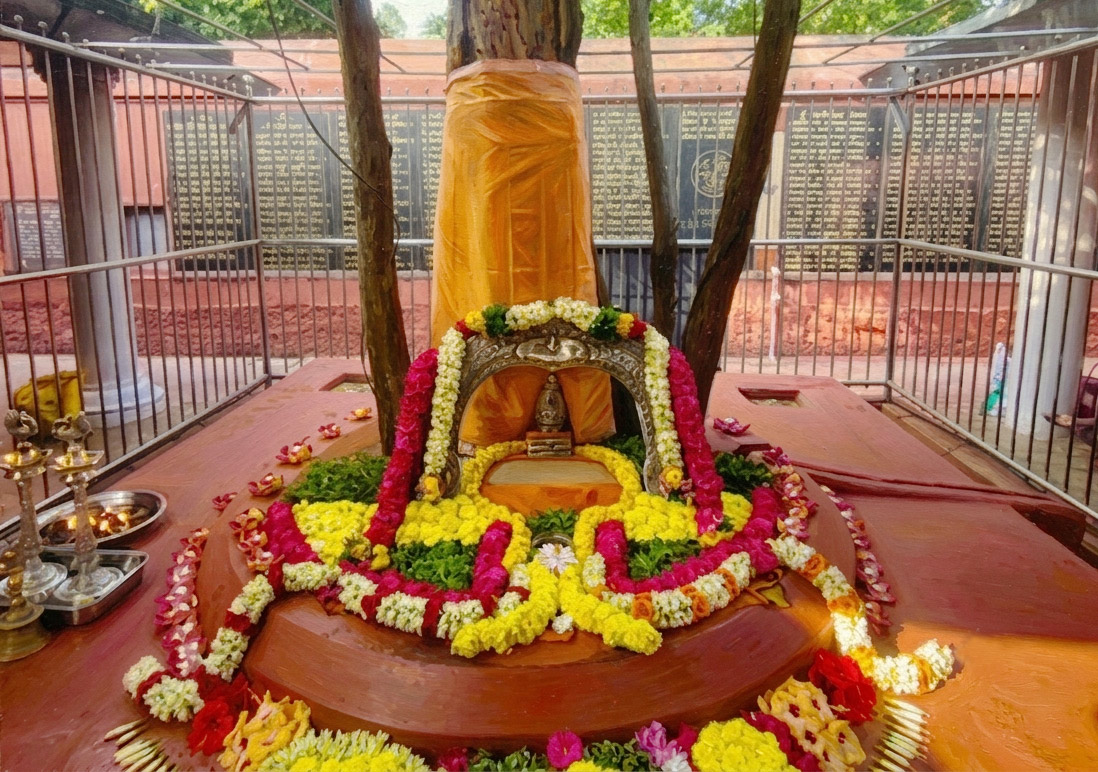
Nerur, Jeeva Samadhi and the Eternal Presence of the Silent Sage
"The body is temporary. The Self is eternal. A realized sage does not die; he simply abides forever in Brahman."
Introduction
Throughout history, humanity has witnessed the lives of extraordinary saints whose influence extended far beyond the limits of their physical existence. Among these rare spiritual luminaries, Sadguru Sri Sadasiva Brahmendra occupies a unique and exalted place. Revered as an Avadhuta, a realized Advaitic master, a mystic composer, and a silent teacher, he demonstrated through his life that the highest spiritual truth lies not in words, rituals, or worldly achievements, but in direct realization of the Supreme Reality.
The preceding chapters of this series explored his miraculous wanderings, divine grace, profound teachings, and immortal compositions. Yet the final phase of his earthly journey reveals an even deeper truth—the transcendence of birth and death itself.
According to the sacred traditions preserved by devotees and revered spiritual lineages, the final resting place of Sadguru Sri Sadasiva Brahmendra is Nerur, situated on the serene banks of the sacred River Kaveri in present-day Tamil Nadu. For countless devotees, Nerur is not merely a geographical location. It is a spiritual sanctuary where silence speaks louder than words and where the presence of the great sage continues to be experienced through unwavering faith and devotion.
This chapter explores the sacred traditions surrounding his Jeeva Samadhi, the spiritual significance of Nerur, and the timeless legacy that continues to illuminate the path of seekers.
The Final Years of the Great Sage
Traditional accounts describe the later years of Sri Sadasiva Brahmendra as a period of complete absorption in Brahman. By then, distinctions of caste, status, wealth, and identity had dissolved in the boundless awareness of the Self.
He wandered freely across the sacred landscapes of South India, often immersed in profound silence. Villagers, ascetics, scholars, rulers, and ordinary devotees encountered him in different ways. Some witnessed acts they regarded as miraculous. Others experienced inner transformation simply through his presence. Many saw in him the living embodiment of Advaita—a sage untouched by worldly dualities.
To the realized master, there was no sense of "I" and "mine." The body had become merely an instrument through which divine grace flowed.
The Spiritual Significance of Nerur
Nerur occupies a cherished place in the hearts of devotees because it is traditionally associated with the Jeeva Samadhi of Sri Sadasiva Brahmendra.
Surrounded by the tranquil beauty of the Kaveri, the atmosphere of Nerur naturally inspires contemplation. The gentle flow of the river, the peaceful surroundings, and the sanctity of the Samadhi create an environment where seekers often experience profound inner stillness.
Pilgrims from across India visit Nerur to offer prayers, meditate, sing his compositions, and seek blessings. For many, the journey is not merely a pilgrimage to a historical site but an inward journey toward silence and Self-realization.
Understanding Jeeva Samadhi
In the spiritual traditions of India, Jeeva Samadhi refers to the state in which a realized master consciously withdraws from ordinary bodily activity while remaining established in the Supreme Consciousness.
For devotees, a Jeeva Samadhi is not viewed as an ending but as a continuing center of divine grace. The realized sage is believed to remain spiritually accessible, guiding sincere seekers through subtle presence rather than physical interaction.
Whether one approaches this concept through devotion or philosophy, the essential message remains the same: the Self is eternal, untouched by birth and death.
Silence That Continues to Teach
Perhaps the greatest teaching of Sri Sadasiva Brahmendra was silence.
He demonstrated that ultimate truth cannot be fully expressed through language. Scriptures point toward it. Teachers explain it. Devotees sing about it. But realization itself dawns only when the restless mind becomes perfectly still.
His silence was never empty. It radiated wisdom, compassion, and freedom. Even today, devotees who sit quietly at his Samadhi often describe a deep sense of peace and inward clarity.
The Living Presence of the Sadguru
Across generations, devotees have preserved countless accounts of receiving guidance, comfort, and inspiration through their devotion to Sri Sadasiva Brahmendra. While such experiences belong to the realm of personal faith and cannot be independently verified, they reflect the profound impact his life continues to have on spiritual seekers.
Many pilgrims visit Nerur seeking:
- Inner peace during difficult times
- Clarity in spiritual practice
- Strength to overcome life's challenges
- Freedom from fear and anxiety
- Deeper devotion to the Divine
- Progress on the path of Self-realization
For them, the Sadguru's grace is experienced not merely as miraculous intervention but as a quiet transformation of the heart.
Nerur as a Spiritual Pilgrimage
A visit to Nerur is often marked by simplicity and reverence. Devotees meditate, chant, read his compositions, and reflect upon the timeless truth of Advaita.
The pilgrimage reminds seekers that spirituality is not confined to external rituals. True worship is the purification of the mind, the cultivation of compassion, and the realization that the same divine consciousness shines within every living being.
The Message Beyond the Samadhi
Sri Sadasiva Brahmendra's life teaches that liberation is not achieved through outward recognition but through inward awakening.
His journey encourages every seeker to:
- Cultivate humility.
- Live with compassion.
- Practice detachment.
- Seek inner silence.
- Remember the Divine.
- Realize the unity of all existence.
These principles remain as relevant today as they were centuries ago.
The Eternal Legacy
The influence of Sri Sadasiva Brahmendra extends across multiple dimensions:
- Advaita Vedanta: His life exemplifies non-dual realization.
- Carnatic Music: His devotional compositions continue to inspire musicians and devotees worldwide.
- Guru Tradition: His example reminds seekers of the transformative power of a realized master.
- Pilgrimage: Nerur remains a cherished destination for spiritual aspirants.
- Devotion: His memory continues to strengthen the faith of countless devotees.
His legacy is not confined to history. It lives in every heart that longs for truth, every voice that sings his compositions, and every seeker who turns inward in search of the eternal Self.
A Reflection for Every Seeker
As we reflect upon the sacred life of Sadguru Sri Sadasiva Brahmendra, we are reminded that the highest spiritual attainment is not measured by miracles or fame but by complete union with the Divine.
His life invites us to look beyond the transient world and discover the timeless presence that resides within.
The silent sage may no longer walk the earth in visible form, yet his message continues to echo through the ages:
"Know yourself. Realize Brahman. Live in compassion. Rest in eternal silence."
Conclusion
The sacred traditions associated with Nerur and the Jeeva Samadhi of Sadguru Sri Sadasiva Brahmendra continue to inspire devotion, contemplation, and spiritual inquiry. Whether approached through history, philosophy, or faith, his life stands as a luminous example of the transformative power of Self-realization.
As this series moves toward its concluding chapter, the journey of the Silent Sage reminds us that while the physical form may pass, the light of realized wisdom continues to guide humanity across generations. Part X will explore his enduring influence on spiritual traditions, music, devotees, and the timeless legacy that continues to illuminate the path of seekers around the world.